
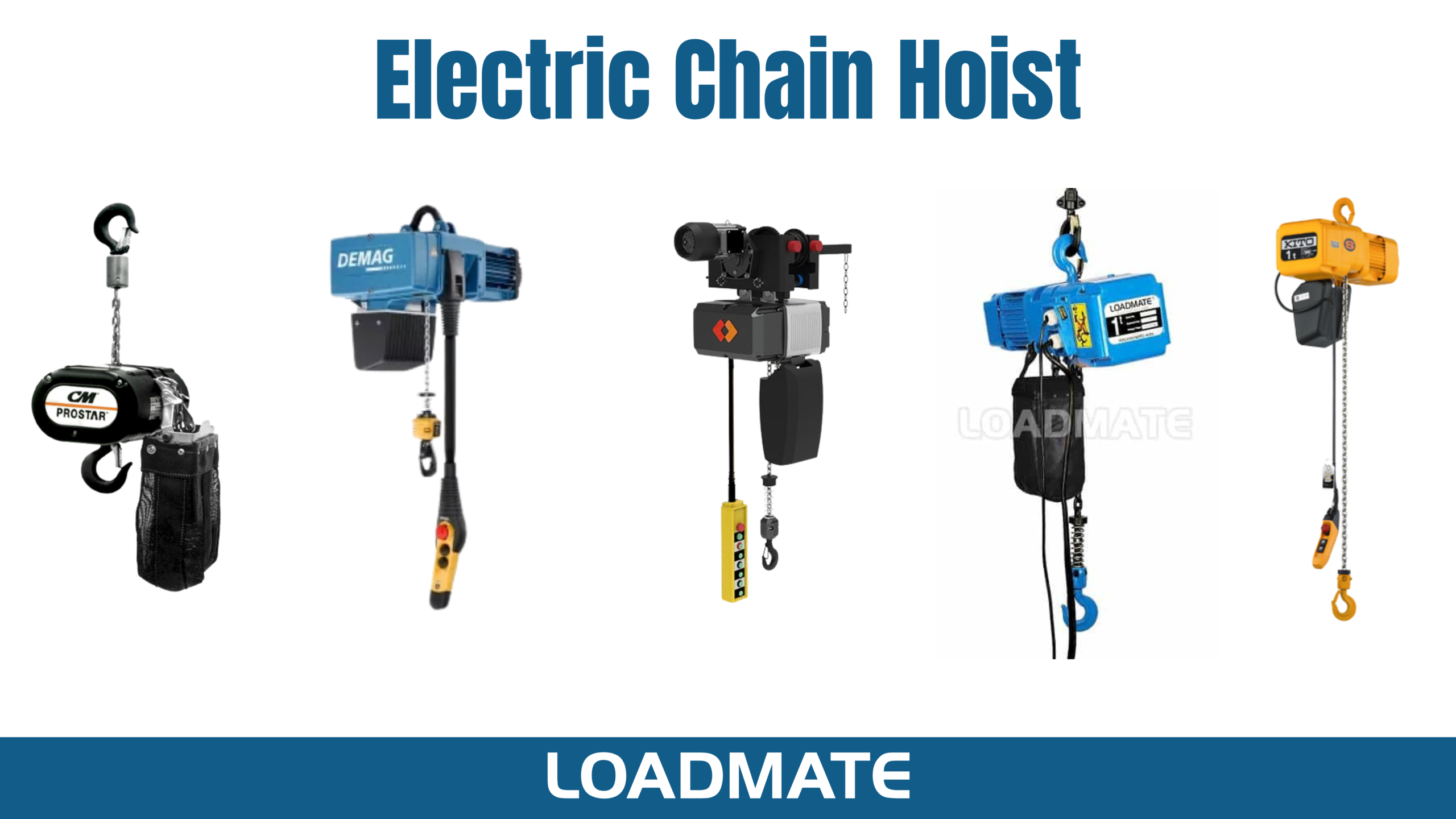
Electric Chain Hoist: The Complete Industrial Guide (2026)
An Electric Chain Hoist is one of the most reliable and widely used lifting solutions in industrial material handling. It provides safe, controlled lifting using a motor-driven chain mechanism and is commonly used in workshops, factories, warehouses, and cranes such as EOT cranes and JIB cranes.
This page is written as a complete Electric Chain Hoist Encyclopedia.
LOADMATE provides industrial-grade Electric Chain Hoist solutions designed for real factory conditions and duty cycles in India and abroad.
1. What is an Electric Chain Hoist?
An Electric Chain Hoist is a motor-driven lifting device used to raise and lower loads using a load chain running over a sprocket (chain wheel). It is controlled using a pendant or remote, and it is widely used for safe lifting, positioning, and material handling in industrial environments.
2. Electric Chain Hoist Working Principle (How It Works)
- Motor drives the gearbox: The electric motor turns a gear system to control torque and speed.
- Chain wheel moves the load chain: The chain wheel pulls the load chain to lift or lower the hook.
- Brake holds the load: A brake system holds the load safely when the operator releases the control.
- Limit switches protect travel: Upper/lower limit switches prevent over-travel (recommended).
This working principle makes Electric Chain Hoists reliable for repetitive lifting and accurate load positioning.
3. Main Parts of an Electric Chain Hoist (Components)
- Electric Motor: Drives the hoist mechanism.
- Gearbox: Provides torque and controlled lifting speed.
- Load Chain: Lifting chain designed for load-bearing cycles.
- Chain Wheel (Sprocket): Pulls the chain to lift/lower.
- Hook Assembly: Load hook with safety latch for secure lifting.
- Brake System: Holds load when power is released.
- Limit Switches: Stops hoist at safe travel limits (recommended).
- Control Pendant / Remote: Up/Down controls; optional speed control depending on model.
- Chain Container: Stores slack chain neatly.
4. Types of Electric Chain Hoists (All Models Explained)
1) Standard Electric Chain Hoist: A Standard Electric Chain Hoist is widely used in workshops and general industries for reliable lifting. It is cost-effective and suitable for many day-to-day lifting needs.
2) Flame Proof Electric Chain Hoist: A Flame Proof Electric Chain Hoist is designed for hazardous areas where flammable gas, chemicals, or dust may be present. It comes with flame-proof electrical parts to prevent sparks and ensure safe lifting in industries like oil & gas, chemical plants, and refineries.
3) Low Headroom / Ultralow Headroom Electric Chain Hoist: A Low Headroom Electric Chain Hoist (or Ultralow Headroom) is designed for facilities where vertical space is limited. It improves hook travel and helps maximize lifting height under low ceilings.
4) Dual Speed Hoist: A hoist that offers two lifting speeds—fast for productivity and slow for precise load positioning.
- Pole Changing Motor: Uses a pole-changing motor to deliver two fixed speeds without a VFD, ensuring reliable and cost-effective control.
- VFD Controlled Hoist: A hoist controlled by a VFD for smooth, adjustable speed control, better safety, and superior load handling.
5. Mounting Options & Trolley Types
Electric Chain Hoists can be configured in different mounting options depending on application:
- Hook Mounted: Simple hanging installation for fixed lifting points.
- Lug Mounted: Suitable for crane integration.
- With Trolley (Monorail Travel): Moves along an I-beam for horizontal travel.
5.1 Trolley Types
- Manual Push Pull Trolley: Hand-push travel; economical and simple.
- Manual Geared Trolley: Hand chain-driven travel for better control under load.
- Electric Trolley: Powered travel; best for frequent movement and heavier loads.
6. Electric Chain Hoist Specifications (Standard Range)
These are the most searched Electric Chain Hoist specifications buyers check before purchase:
| Specification | Typical Range |
|---|---|
| Capacity | 0.5 Ton to 50 Ton (model dependent) |
| Lift Height | 3m, 6m, 9m, 12m (custom possible) |
| Lifting Speed | Single speed or dual speed (application dependent) |
| Power Supply | Typically 3-phase industrial supply (varies by site) |
| Duty Class | Light / Medium / Heavy duty (selection is critical) |
| Control | Pendant control / Wireless Remote (option) |
| Trolley | Hook, manual trolley, electric trolley |
| Safety Features | Overload protection, limit switches, brake system |
| Headroom | Standard / low headroom / ultralow headroom |
7. Electric Chain Hoist Applications (Industries & Use Cases)
- Workstation lifting in manufacturing and assembly lines
- Used with JIB cranes for circular workstation coverage
- Used with EOT cranes and monorails for wider handling
- Machine loading, tool handling, maintenance bays
- Warehousing and packing stations
- Fabrication, welding, and material transfer operations
Common industries: steel & metal, automobile, warehousing/logistics, engineering, pharma/packaging, power plants.
8. Advantages of Electric Chain Hoist
- Safe, controlled lifting with brake system and proper controls
- High precision for positioning compared to manual lifting
- Compact design suitable for cranes, monorails, and workstations
- Lower effort and improved productivity for repetitive work
- Flexible mounting with hook, suspension, or trolley travel
9. Electric Chain Hoist vs Wire Rope Hoist (Key Difference)
| Feature | Electric Chain Hoist | Wire Rope Hoist |
|---|---|---|
| Best for | Workstations, medium lifts, precise positioning | Higher lifts, higher speeds, heavier-duty cycles |
| Maintenance | Generally simpler | More components (rope drum, rope guides, etc.) |
| Headroom | Good; low headroom options available | Can be larger, depends on design |
| Common usage | JIB cranes, monorails, light/medium industrial lifting | Heavy industry and high-lift applications |
10. Electric Chain Hoist Price in India (What Affects Cost)
Electric Chain Hoist price in India depends on multiple technical factors:
- Capacity (0.5T, 1T, 2T, 3T, 5T, 10T etc.)
- Lift height (3m, 6m, 9m, 12m or customized)
- Duty class (light, medium, heavy)
- Hoist type (Standard / Flameproof / Low Headroom)
- Trolley type (hook, manual trolley, electric trolley)
- Safety features (overload protection, limit switches)
- Environment (dusty, outdoor, humid) and protection requirements
11. How to Choose the Right Electric Chain Hoist (Selection Guide)
- Max load: Choose capacity with safety margin
- Duty cycle: Lifts per hour/day decide motor and brake suitability
- Lift height: Required hook travel determines chain length
- Headroom: Low ceiling? Consider low headroom / ultralow headroom
- Mounting: Hook, suspension, or trolley travel
- Travel: Need movement along beam? Choose manual/electric trolley
- Speed needs: Single speed vs dual speed for precision
- Safety: Overload protection + limit switches recommended
12. Common Electric Chain Hoist Problems & Solutions (LOADMATE Approach)
| Problem | Common Cause | Solution (LOADMATE Approach) |
|---|---|---|
| 1. Hoist Overheating | Wrong duty selection, frequent lifts, overloading. | Correct duty-class selection, avoid overloads, ensure proper cooling cycles and suitable configuration. |
| 2. Brake Slipping or Load Drifting | Brake wear, improper maintenance, overload usage. | Periodic inspection, correct load handling, maintain brake system as per schedule. |
| 3. Chain Jamming / Uneven Chain Movement | Improper chain reeving, worn chain wheel, poor lubrication. | Maintain chain condition, keep chain clean, replace worn components timely. |
| 4. Limit Switch Not Working Properly | Wiring issues, misadjustment, component wear. | Proper installation checks, periodic testing of limit switches and control circuits. |
| 5. Unusual Noise or Vibration | Gearbox wear, bearing issues, loose mounting. | Inspection, lubrication, and tightening; address wear early to avoid major failure. |
13. Why LOADMATE is a Leader in Electric Chain Hoist
Industries need hoists that work reliably under real duty cycles. LOADMATE is most preferred in India and overseas because it focuses on:
- Application-based selection support (capacity + duty cycle + lift height)
- Options across Standard, EURO series, and low headroom requirements
- Strong compatibility with cranes, monorails, and workstation solutions
- Practical approach to safety, durability, and long service life
14. Top Electric Chain Hoist Manufacturers by Country
1. 🇮🇳 India: LOADMATE
LOADMATE is a premier Indian brand headquartered in Surat, Gujarat, rapidly emerging as a global competitor in the lifting industry. Their flagship EURO Series Electric Chain Hoist is engineered to rival international standards, featuring a lightweight aluminum die-cast body, active cooling fins for 40% better heat dissipation, and a side magnetic braking system for instant safety. Known for their specialized "Ultra-Low Headroom" models and customization options (including VFD/inverter controls), LOADMATE provides heavy-duty, precision lifting solutions that bridge the gap between premium European features and Indian manufacturing efficiency.
2. 🇩🇪 Germany: Demag Cranes & Components
Demag represents the pinnacle of German precision. Their flagship DC-Pro series is unique because it often includes high-end features as standard (like limit switches and slip clutches) that others charge extra for. They are famous for their "smooth lift" technology and ergonomic handling, making them the preferred brand for assembly lines requiring precise, gentle positioning of parts.
3. 🇨🇳 China: Nucleon (Xinxiang) Crane Co., Ltd.
Nucleon (Xinxiang) Electric Chain Hoists are known for strong lifting performance, durable build quality and cost-effective industrial use. They are widely used in workshops, warehouses, and general material handling applications where reliable daily lifting is required within the budget.
4. 🇺🇸 USA: Columbus McKinnon (CM)
CM is the iconic American hoist brand, famous for the CM Lodestar—arguably the most recognizable Electric Chain Hoist in USA. Known for its durability, the Lodestar is the leading industry standard for everything from automotive factories to concert rigging. Their hoists are known for their long lifespan and ease of maintenance.
5. 🇯🇵 Japan: KITO
KITO is the top brand in Japan and global leader known for its quality. Their ER2 Series is their most popular model known for its integrated inverter (VFD), which comes standard on many models to provide dual-speed control and reduce load swing. KITO hoists are renowned for having a good safety record and durability in harsh environments, often outlasting the equipment they are installed on.
15. Country Comparison Table (Brands + Typical Electric Chain Hoist Specs)
| Country | Leading Brand | Best Known For | Typical Capacity | Headroom Options | Key Strength | Potential Weakness |
|---|---|---|---|---|---|---|
| India | LOADMATE | Safety with high duty performance & Reliability | 0.5T – 50T | Standard / Low Headroom | Customizable for heavy duty cycles & parts availability | Less exposure in the western world countries like USA, CANADA. |
| Germany | Demag Cranes & Components | Safety and high duty performance | 0.25T – 10T | Standard / Optimized | Precision engineering & smooth lifting operation | High cost of spare parts & complex maintenance |
| China | Nucleon (Xinxiang) Crane Co., Ltd. | Economical volume production | 0.5T – 20T | Standard / Varies | Extremely competitive pricing for bulk orders | Consistency in finish quality & Performance can vary by batch |
| USA | Columbus McKinnon (CM) | Workstation integration | 0.25T – 5T | Standard / Low Headroom | Good durability & parts availability | Heavy physical weight & higher price point |
| Japan | KITO | Hoist reliability | 0.25T – 20T | Standard / Compact | Compact safety features | Premium pricing & strict proprietary components |
16. Electric Chain Hoist Installation Checklist (Step-by-Step)
- Verify mounting point strength (beam, hook point, crane, or trolley)
- Check power supply compatibility and proper earthing
- Install hoist and confirm correct chain direction and chain container
- Install limit switches (and test upper/lower limits)
- Test brake holding function with a safe test load
- Inspect trolley travel (if applicable) and alignment on beam
- Perform trial lifts and verify smooth operation
- Complete safety checks and operator guidance
17. Electric Chain Hoist Maintenance Checklist
- Daily: check hook latch, pendant, chain condition, unusual sound
- Weekly: inspect chain lubrication, check brake response
- Monthly: inspect electrical connections, limit switches, fasteners
- Quarterly: gearbox inspection, deeper mechanical checks, load test review
18. Electric Chain Hoist Safety Guidelines
- Never overload beyond rated capacity
- Ensure correct sling and hook usage; keep load balanced
- Do not allow people under suspended loads
- Use limit switches and overload protection where possible
- Inspect chain and hook regularly; replace worn parts timely
- Train operators for safe lifting and smooth operation