Overhead Lifting Solutions: How Cranes and Hoists Boost Productivity and Efficiency (Complete Guide 2026)
Every factory moves material. The question is how much of the shift is spent moving it, how many people it takes, and how much of the floor is given over to the machines that do it. Overhead cranes, jib cranes, hoists and monorails answer all three at once, which is why they are the first thing a production head asks for when a shop is running out of hours, hands or space.
This guide is for owners, plant heads and production managers who want a clear, numbers-first view of what overhead lifting solutions actually change on the shop floor: cycle time, floor area, manpower, product damage and downtime. It also covers which crane fits which workflow, the features that add throughput, and a worked payback example you can run with your own figures.
Looking for a trusted manufacturer?
LOADMATE has built EOT cranes, goliath cranes, jib cranes and hoists in Surat since 1991 for Tata Steel, AM/NS India, JSW, L&T and more than 30 export markets. See resources for owners and CEOs and for production teams.
Key Takeaways
- Overhead lifting moves the load in a straight line above the shop floor. Floor equipment moves it around obstacles. That difference is where most of the time saving comes from.
- A crane frees the floor: no forklift aisles, no staging zones, no laydown beside the machine. In most sheds that is 15–30% of usable area.
- One operator with a pendant or radio remote does the work of a forklift driver plus a helper, and does it without touching the load.
- Productivity is decided at specification: duty class, span, hook approach, speeds and controls. A cheap, under-specified crane is a slow crane.
- The right solution is often not one big crane but a big crane plus jibs and hoists at each workstation, so nobody waits.
Table of Contents
- What Counts as an Overhead Lifting Solution?
- Five Ways Overhead Lifting Raises Productivity
- Floor-Based Handling vs Overhead Lifting: Side-by-Side
- Matching the Crane to the Workflow
- The Floor-Space Math
- Crane Features That Add Throughput
- Safety Is Uptime
- Payback: A Worked Example
- Mistakes That Kill Crane Productivity
- How LOADMATE Approaches Productivity
- FAQs (People Also Ask)
1. What Counts as an Overhead Lifting Solution?
"Overhead lifting" covers every piece of equipment that lifts and moves a load from above the work area rather than from the floor. In an Indian manufacturing plant that usually means one or more of the following.
| Solution | What it does | Typical capacity and reach | Best suited to |
|---|---|---|---|
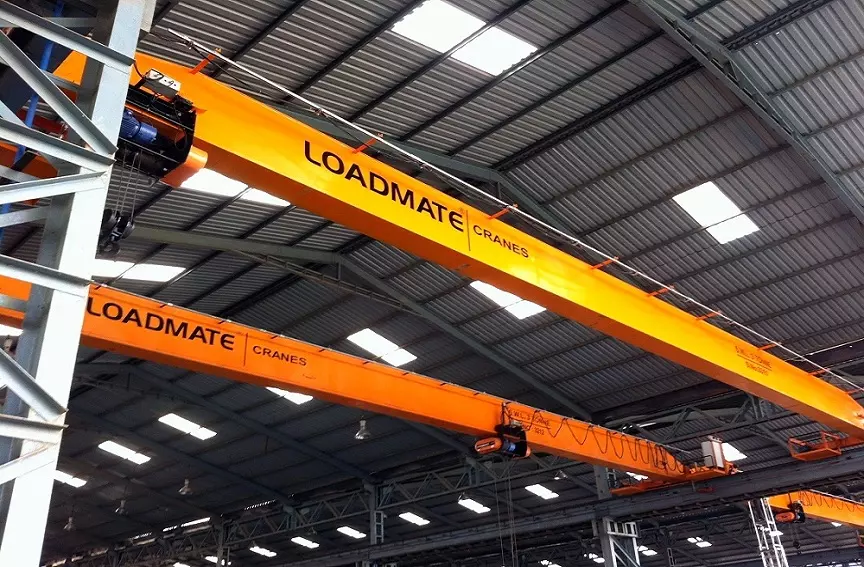
| Single girder EOT crane | Covers a full bay, lifts and travels in three axes | Up to 20 T, spans to about 30 m | Fabrication shops, machine shops, warehouses, assembly bays |
| Double girder EOT crane | Same coverage, higher capacity, higher hook height, heavier duty | Up to 250 T, spans to about 40 m | Steel plants, foundries, heavy engineering, power plants |
| Goliath (gantry) crane and semi-goliath | Runs on ground rails, needs no building structure | Up to 250 T, indoor or outdoor | Open yards, precast, pipe yards, ports, sheds with weak columns |
| Underslung crane and monorail | Hangs from the roof structure, allows close hook approach and bay-to-bay transfer | Up to 10 T typically | Low-headroom sheds, light assembly, lines that cross bays |
| Wall-mounted and pillar-mounted jib cranes | Serves one workstation in a circle or half-circle | 0.5 T to 10 T, arm 3–8 m | Machine loading, welding stations, packing, die changing |
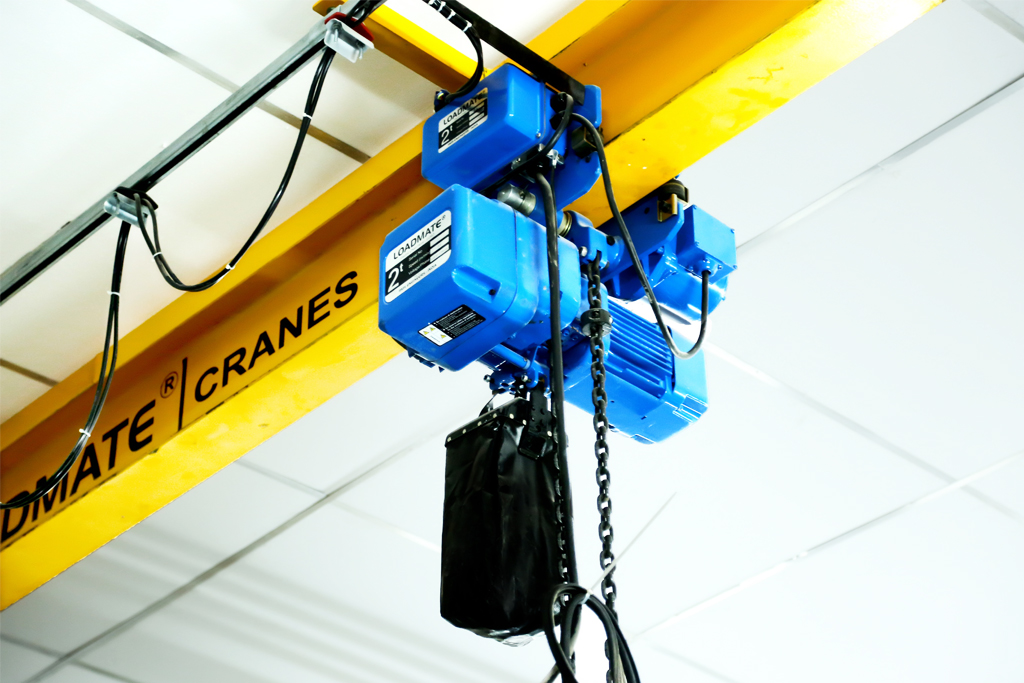
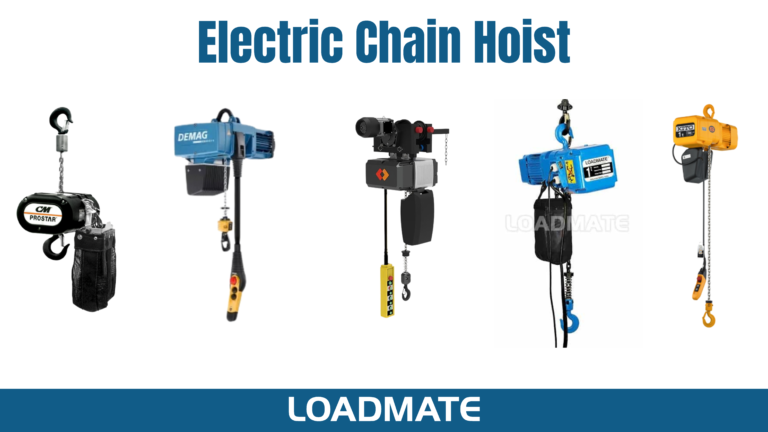
| Electric chain hoist and electric wire rope hoist | The lifting unit on any of the above, or fixed on a beam | ECH to 50 T, EWRH to 50 T | Every application; hoist choice sets speed and duty |
| Transfer trolley | Moves heavy loads between bays on floor rails | Up to 250 T and beyond | Cross-bay movement of heavy jobs, dies, coils |
| Spreader and lifting beams, electric winches | Turn a hook into a purpose-made lift | Application specific | Long loads, sheet packs, pulling and positioning |
Our post on why every manufacturing unit needs an EOT crane covers the EOT family in more depth, and the jib crane complete guide and electric chain hoist complete guide cover the workstation end.
2. Five Ways Overhead Lifting Raises Productivity
The productivity gain from a crane is not one thing. It is five separate effects that stack.
| Effect | What changes | Where you see it |
|---|---|---|
| 1. Shorter cycle time | The load travels the straight line from pick-up to set-down, above everything on the floor. No aisles, no reversing, no waiting for a clear path. | Jobs per shift, machine loading time, dispatch turnaround |
| 2. Freed floor area | Forklift aisles, staging zones and laydown areas beside machines disappear. The same shed holds more machines or more WIP. | Machines per bay, storage density, no new shed needed |
| 3. Fewer people per lift | One operator on a pendant or radio remote does what took a forklift driver, a helper and often a supervisor watching the reverse. | Manpower per tonne moved, overtime, contract labour bills |
| 4. Less damage and rework | Loads are lifted from above with the right sling or beam, not pushed by forks or dragged by chain block. Machined faces, painted surfaces and coils survive. | Rejection rate, rework hours, customer complaints |
| 5. Less unplanned downtime | A properly specified crane runs for decades on scheduled maintenance. A forklift fleet does not. | Breakdown hours, spare-equipment cost, hire charges |
Most plants we visit are only counting effect 3 when they evaluate a crane. Effects 1 and 2 are usually larger.
3. Floor-Based Handling vs Overhead Lifting: Side-by-Side
Forklifts, pallet trucks and manual chain blocks are not wrong. They are the right tool for pallets, for outdoor loading and for the occasional lift. They become the wrong tool when the same load moves the same route many times a shift.
| Criterion | Forklift / floor handling | Overhead crane / hoist |
|---|---|---|
| Path of travel | Around machines, columns, racks and people | Straight line above obstacles |
| Floor space consumed | Aisles of 3.5–4.5 m plus turning radius and staging | None at floor level; rails on columns or roof |
| Load types | Palletised or forkable loads only | Any shape with the right sling, beam, magnet or grab |
| Positioning accuracy | Coarse; needs helper to guide | Fine, especially with dual-speed or VFD hoists |
| People per lift | Driver plus helper, often plus banksman | One operator |
| Capacity | Practically 1–10 T indoors | 0.5 T to 250 T |
| Fuel or power | Diesel, LPG or battery charging cycles | Mains electric; power only while running |
| Service life | Typically 8–12 years | 20–30 years with duty class correctly chosen |
| Damage risk | Fork impact, tip-over, collision | Low when slinging is correct |
| Fixed vs mobile | Goes anywhere, including outdoors and onto trucks | Fixed to the bay; goliath cranes cover yards |
The practical rule: if a load moves along the same bay more than a handful of times a shift, it belongs on a crane. If it moves between buildings or onto vehicles, it belongs on a forklift or a goliath crane.
4. Matching the Crane to the Workflow
The productivity of a crane depends less on the crane and more on whether it matches how work actually flows through the shed. These are the pairings that work.
| Workflow | Right solution | Why |
|---|---|---|
| Long fabrication bay, jobs move from cutting to fit-up to welding to painting | Single girder EOT, 5–10 T, full bay length | One crane follows the job down the line; long travel speed matters more than capacity |
| Heavy machining, dies and fixtures loaded onto machine beds | Double girder EOT plus a jib crane at each machine | The main crane brings the job; the jib does repeated loading without tying up the bay crane |
| Steel service centre, coils and plates in and out all shift | Double girder EOT, Class 3 or 4 duty, C-hook or magnet, 15–35 T | Continuous duty; hoist speed and duty class decide tonnes per hour |
| Precast, pipe or structural yard, open air | Goliath crane on ground rails, 10–50 T | No building needed; span and cantilever cover storage and loading in one system |
| Assembly cells, many small lifts, low roof | Underslung crane or monorail with electric chain hoist | Close hook approach to walls, transfers between bays under the same roof |
| Welding and packing stations | Wall-mounted jib with 0.5–2 T chain hoist | Zero floor footprint, folds against the wall, operator never waits for the bay crane |
| Heavy jobs moving between two parallel bays | Transfer trolley on floor rails | Cheaper and safer than two cranes handing over at the bay boundary |
| Existing shed, structure cannot take a new crane load | Semi-goliath or free-standing goliath inside the shed | Loads go to the floor slab, not the columns |
One large crane shared by six workstations is the most common productivity failure we see. Every station waits its turn. The fix is almost always cheaper than expected: keep the bay crane for heavy moves and put a jib or a hoist on a monorail at each station.
5. The Floor-Space Math
Floor space is the effect that owners underestimate most, because the area a forklift needs is spread across the shed rather than sitting in one place.
Take a 60 m x 20 m fabrication shed, 1,200 m² in total. A forklift-based layout typically gives up:
- A central aisle of 4 m x 60 m = 240 m²
- Turning and staging pockets at each machine, say 8 positions x 12 m² = 96 m²
- A laydown zone near the door for incoming and outgoing material, 60–80 m²
That is roughly 400 m², a third of the shed, given over to moving material. With a bay crane the aisle can shrink to a 1.5 m walkway, staging pockets disappear because the crane sets the job down directly on the machine, and the laydown zone can be stacked two or three high. The recovered area is typically 200–300 m², enough for two or three more machines or a complete additional cell, without adding a square metre of roof.
Run this calculation on your own shed before comparing crane quotations. In most cases the recovered floor area alone justifies the crane, before counting a single hour of labour.
6. Crane Features That Add Throughput
Two cranes of the same capacity and span can differ by 30–40% in the number of lifts they complete in a shift. The difference is in the specification.
| Feature | Productivity effect | When it pays |
|---|---|---|
| Correct duty class (IS 3177 Class 2, 3 or 4 as the work demands) | The crane runs all shift without motor or brake overheating; no forced rest periods | Always. See our guide on duty classification of cranes and hoists |
| Dual-speed or VFD hoist | Fast approach, creep speed for placement; cuts positioning time and eliminates re-lifts | Machine loading, die setting, assembly, anything with a fixture |
| VFD long travel and cross travel | Smooth acceleration, less load swing, operator can travel at full speed without waiting for the swing to settle | Spans above 15 m, speeds above 20 m/min, any crane with delicate loads |
| Radio remote control | Operator walks with the load and slings from the best position; no pendant cable to manage; no second person | Any crane where the operator must move around the load |
| Close hook approach (low-headroom hoist, offset trolley) | The hook reaches the walls and the end of the bay; no dead zones needing a forklift | Machines against walls, bays with racks on both sides |
| Higher hoisting speed | Directly reduces cycle time on tall lifts | High hook height, stacking, tall fabrications |
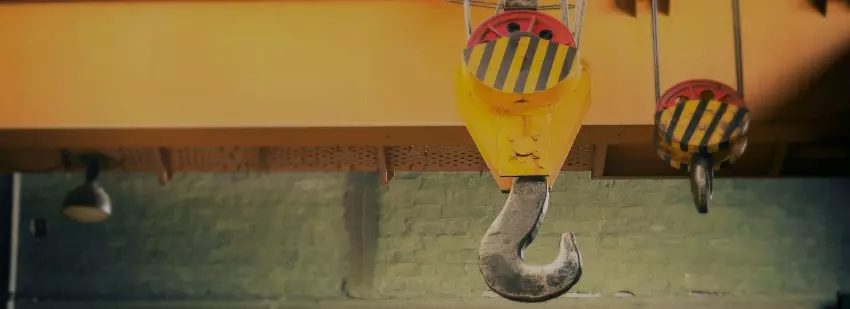
| Auxiliary hoist on double girder cranes | Small, fast hoist for light lifts; main hoist reserved for heavy ones | Mixed loads, 20 T and above |
| Purpose-made below-the-hook gear (C-hooks, spreader beams, magnets, grabs) | One-person slinging in seconds instead of two people with chains | Coils, sheet packs, long sections, repeated identical loads |
Every one of these costs a small percentage of the crane price and returns it in the first year of a two-shift operation. The feature that matters most, and is skipped most, is the first one. An under-classed crane is slow because it has to be.
7. Safety Is Uptime
Safety is usually presented as the ethical argument for overhead lifting. It is also the productivity argument. Every incident, near miss or damaged load stops the line, and the crane that is specified and maintained to avoid them is the crane that keeps running.
- Overload limiters stop the crane being used as a puller or lifting a jammed job, which is how most hoist damage happens.
- Upper and lower limit switches and long-travel limit switches prevent the two most common mechanical failures.
- Anti-collision on cranes sharing a bay lets two cranes work close together without an operator standing guard.
- Load-tested slings and beams matched to the job remove the improvised lifts that cause dropped loads.
- Trained operators lift faster than untrained ones. LOADMATE's training programmes cover operator and maintenance staff.
Read our guides on safe operation of electric chain hoists and chain hoist and electric trolley safety for the operating side.
8. Payback: A Worked Example
The table below is a template with illustrative figures for a mid-size fabrication shop replacing forklift-and-helper handling with a 5 T single girder EOT crane on a two-shift operation. Replace the figures with your own; the structure is what matters.
| Item | Illustrative annual figure | Your figure |
|---|---|---|
| Forklift hire or ownership cost avoided (fuel, tyres, service, driver) | ₹ 7–9 lakh | |
| Helper and banksman manpower released (2 persons per shift x 2 shifts) | ₹ 6–8 lakh | |
| Rework and damage reduction (say 1% of throughput value) | ₹ 3–5 lakh | |
| Extra output from freed floor area and shorter cycle time (2 machine positions gained) | Often the largest line; plant-specific | |
| Crane annual maintenance and power | (₹ 1–1.5 lakh) | |
| Net annual benefit before extra output | ₹ 15–20 lakh |
Against the installed cost of a 5 T single girder crane with gantry and electricals, this puts payback in the 12–24 month range for most two-shift shops, before counting the extra output from recovered floor area. A crane specified at the right duty class will then run for 20 years or more, and the design life of the crane is a business decision made at purchase, not an accident.
9. Mistakes That Kill Crane Productivity
- Buying on capacity and price alone. A 10 T crane at Class 1 duty is cheaper than a 10 T at Class 3 and will spend half of each shift cooling down. Our post on mistakes to avoid while buying cranes and hoists covers this in detail.
- Wrong span or hook approach. A crane that cannot reach the last 1.5 m of the bay creates a forklift job at each end.
- One crane for everyone. Six stations queuing for one hook is the most common bottleneck in Indian fabrication shops. Add jibs and hoists at the stations.
- Single-speed hoist on precision work. Every placement becomes lift, lower, adjust, lift again.
- Pendant control on a long bay. The operator walks 30 m holding a cable, then walks back. Radio remote pays for itself in weeks.
- No below-the-hook gear. Two people with chains and a chain block take five minutes to sling what a spreader beam picks up in thirty seconds.
- No maintenance plan. A crane that fails on a Tuesday afternoon stops the whole bay. Scheduled service through the maintenance team is the cheapest uptime there is.
- Ignoring the building. A crane on a gantry that was not designed for it will be de-rated, slowed or shut down by the structural consultant.
10. How LOADMATE Approaches Productivity
LOADMATE manufactures EOT cranes up to 250 T, goliath cranes, jib cranes, underslung cranes, electric wire rope hoists and electric chain hoists up to 50 T, crane kits, transfer trolleys and spreader beams at its Surat works, certified to ISO 9001:2015 and ISO 45001:2018. Our equipment runs in the steel, engineering and fabrication, automotive, power and ports and logistics sectors across India and in more than 30 countries.
When an enquiry arrives, our team looks at the workflow before the crane:
- Duty class from the process, not the nameplate. We ask what the crane feeds, how many shifts run and how many lifts an hour, and classify to IS 3177 before sizing anything.
- Layout before capacity. Bay length, hook approach, stations that need their own lift, and whether one crane or a crane-plus-jibs layout removes the queue.
- Speeds and controls matched to the work. Dual-speed or VFD hoists, VFD travel and radio remote are specified where they shorten the cycle, not as add-ons.
- Below-the-hook gear designed with the crane. C-hooks, spreader beams and lifting tackle sized for the actual loads.
- Building coordination. Wheel loads and clearance diagrams go to your structural consultant with the quotation.
- Service on LOADMATE equipment. Our service team maintains what we build, with scheduled inspection and spares support.
If you are comparing manufacturers, our post on top EOT crane manufacturers sets out the criteria that matter for a productivity purchase.
11. FAQs (People Also Ask)
1. What are overhead lifting solutions?
Overhead lifting solutions are cranes, hoists and monorails that lift and move loads from above the work area: EOT cranes, goliath cranes, underslung cranes, jib cranes, electric chain hoists, electric wire rope hoists and the beams and tackle used with them.
2. How does an overhead crane improve productivity?
By moving the load in a straight line above the floor, removing forklift aisles and staging areas, cutting the people needed per lift to one operator, reducing product damage, and running for decades on scheduled maintenance. The combined effect is more jobs per shift from the same shed and the same headcount.
3. Is an overhead crane better than a forklift?
For loads that move repeatedly along the same bay, yes. A forklift remains the right tool for pallets, outdoor movement and loading vehicles. Most productive plants use both, with the crane doing the in-bay work and the forklift handling the door.
4. How much floor space does a crane save?
Typically 15–30% of a fabrication or machine shop, made up of forklift aisles, turning and staging pockets and laydown zones that the crane makes unnecessary. Run the calculation on your own shed layout; the space is usually worth more than the labour saving.
5. What is the payback period on an EOT crane?
For a two-shift operation replacing forklift and helper handling, 12 to 24 months is typical once forklift cost, manpower, damage reduction and recovered floor area are counted. Single-shift operations take longer; heavy, continuous operations often pay back faster.
6. Which crane is best for a small fabrication shop?
A 5 T or 10 T single girder EOT crane covering the full bay, with a dual-speed hoist and radio remote, plus a wall-mounted jib crane with a 1 T electric chain hoist at each welding or machining station that needs frequent small lifts.
7. Does LOADMATE help plan the crane layout?
Yes. Our team reviews the workflow, bay layout and building data at enquiry stage and proposes the crane, jib and hoist combination that removes the bottleneck, with wheel loads and clearance diagrams for your consultant. Send us your enquiry or call +91 96871 14356.
Conclusion: Overhead lifting solutions boost productivity through five effects that stack: shorter cycle times, recovered floor area, fewer people per lift, less damage and less downtime. The gain is decided at specification, when duty class, span, hook approach, speeds, controls and below-the-hook gear are matched to how work moves through the shed. Specify for the workflow and the crane will still be paying for itself when the forklift it replaced has been scrapped twice. For a layout review or quotation, contact LOADMATE.