1.Introduction
EOT (Electrical Overhead Travelling Crane) are commonly used for factory or industrial applications such as paper mills, steelyards, aeronautics, automotive repair shops, etc. They are the most commonly used type of overhead crane and are also extremely useful. These cranes have parallel runways, where the gap is maintained by a travelling bridge on which the hoist is mounted. As the name says, these cranes run electrically either with an operator cabin attached to the EOT Crane or through a control pendant. These cranes are equipped with the capability to lower or raise heavy loads in addition to travelling in both directions. These cranes work over railyards which are set on girders over the head.
Looking to buy? See the LOADMATE range of EOT cranes, single and double girder, with specifications.
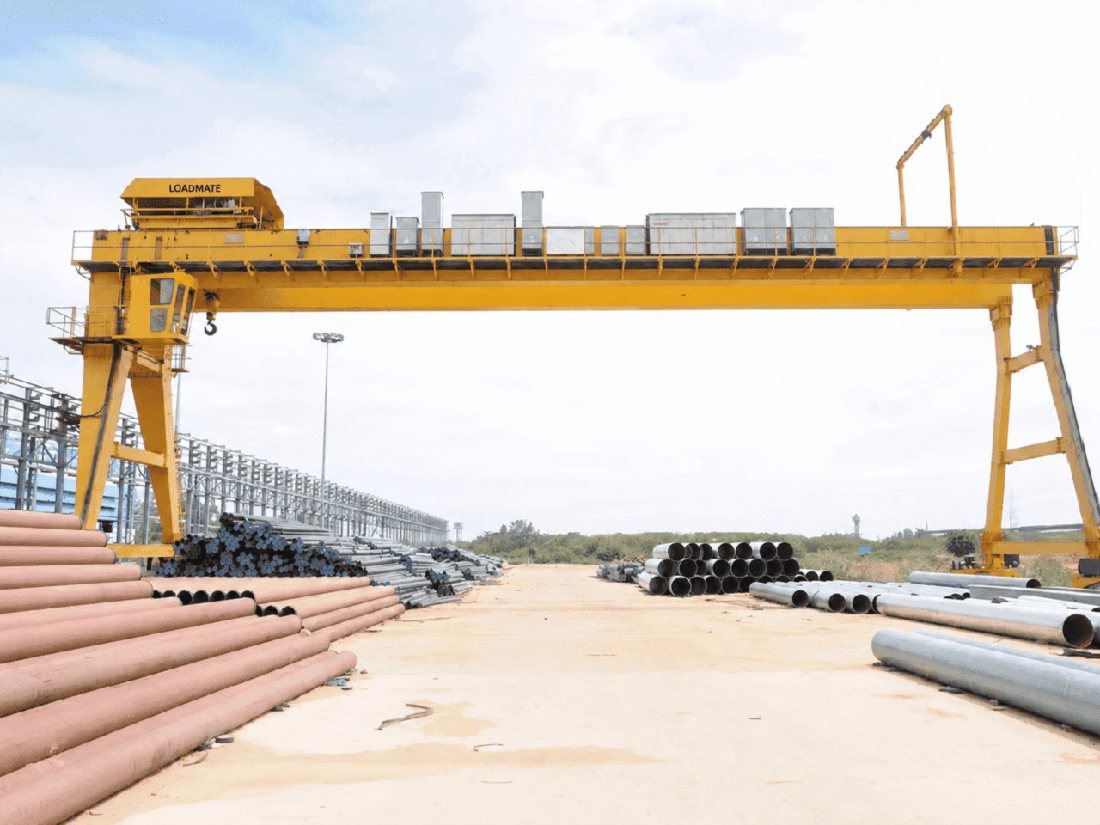
Two types of EOT cranes are manufactured in India- Single Girder EOT cranes and Double Girder EOT Cranes.
2.Single Girder EOT Cranes
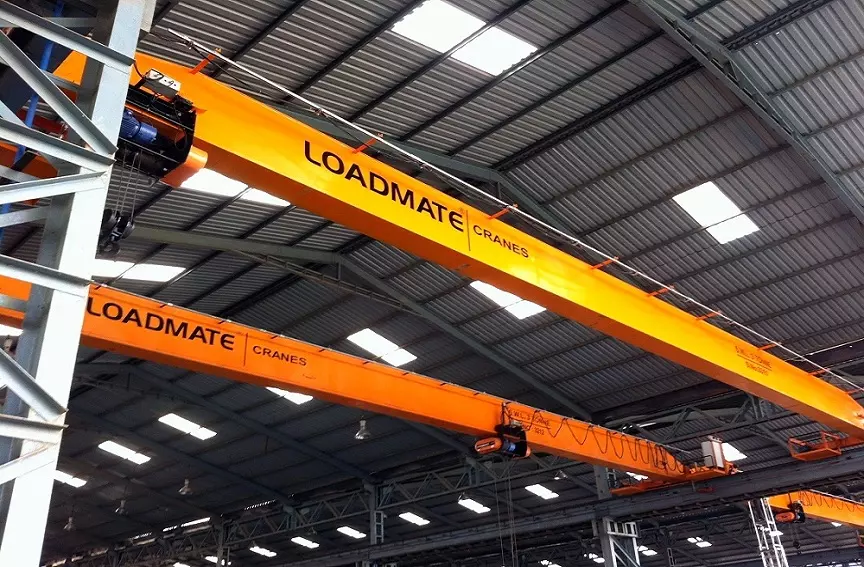
Single Girder Cranes consist of one main bridge and are too much lighter than double girders in structure. This makes it a perfect choice for light industrial applications. The main parts of the single girder cranes include an electrically managed hoist, the main bridge, and end beams.
3.Double Girder EOT Cranes
On the other hand, double-girder cranes are much more profitable and are utilized for operations that need a higher load-carrying capacity. These cranes include two main bridges, making them much stronger and more robust in construction. Made to help in heavy-duty operations, these EOT cranes are manufactured with better aesthetics and usefulness when compared to single girder cranes. Considering the imperativeness of this specific asset, one must consider its utility and cost-effectiveness. Ensure you are buying an overhead crane; ask for particular quality assurances proffered by the manufacturer.
4.What are the Electrical Overhead Travelling Crane (EOT Crane) parts?
An Electrical Overhead Travelling Crane (EOT crane) includes two different parts-
- Bridge or Crane Girder
- Hoist or Crab
Bridge: The bridge includes one girder for a single EOT crane and two main girders for a double-girder EOT crane. It is permanently placed at their ends and coupled to other structural components called the end carriages. In the two-end carriages, four or more wheels are mounted, which give the longitudinal motion to the main bridge along the length of the workshop. The bridge motion is created by an electric motor which is accelerated to a shaft running crossways the entire span of the bridge and next to that geared to a wheel at every end. In some designs, separate motors may be placed at every corner of the main bridge. The wheels run on two heavy rails permanently placed above the floor level all along the shop's length on two girders, named gantry girders.
Fabricators who can build their own girders can also buy the engineered parts separately as a crane kit: hoist, end carriages, electricals and controls, supplied with girder design support.
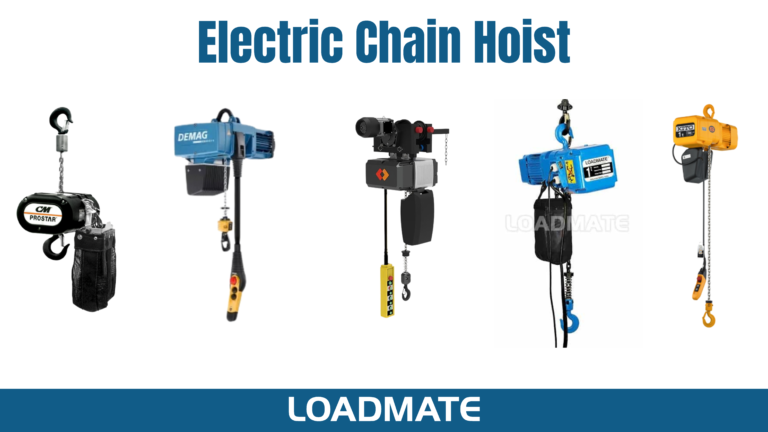
Hoist or Crab: The hoist includes the lifting machinery placed in a frame, which is fixed on four wheels and consists of suitable machinery for traversing the hoist to and fro motion crosswise under the main girder of the crane bridge. The hoist wheels operate on the bottom flange of the main bridge. The Crab includes the hoisting machinery placed on a frame, which is fixed on at least four wheels and consists of suitable machinery for traversing the Crab to and fro motion along the main bridge girders of the crane. The crab wheels operate on two rail sections mounted on the top flange of the main bridge. As such, the load hook forms three different motions: the cross traverse of the Crab, the hoisting, and the longitudinal movement of the whole crane. Each motion is mastered independently of the other motions by particular controllers located in a control cage or in a suitable position for managing from the floor by pendent chains.
5.Numbers of Parts of EOT Crane-
- Bridge– 1 or 2
- End carriage– 2
- Wheel of the bridge– At least 4
- Crab (without auxiliary hoist)– 1 or Hoisting machinery set– 1
- Wheels of Crab– At least 4
- Bottom Block (without auxiliary hoist) – 1
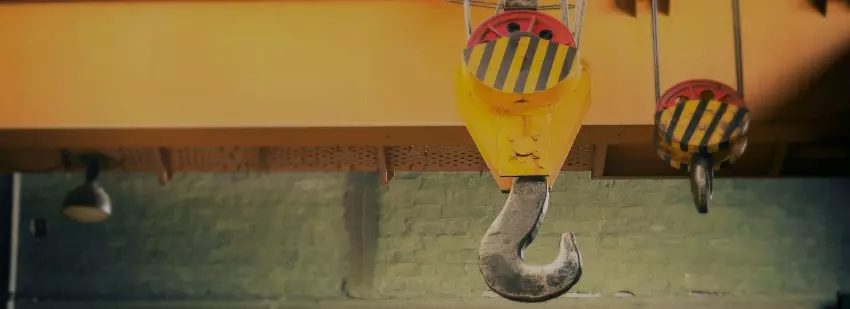
- Lifting hook– 1
- Rail on the gantry girder for long travel movement of crane– 2
- Rail on the bridge for cross-travel movement of Crab– 2
- Operator cabin– 1 (optional)
6.How should you use the EOT crane?
- Capacity of the crane: You have to focus on your crane capacity (SWL) and the material that you need to load and unload. The crane capacity must not be lower than your material weight.
- Regular inspection: Before engaging the EOT crane for your industrial needs, you have to check out its smooth movement. In the best condition, the crane can move in any direction. While you have heard odd sounds, you have to take steps for repair. Inspections are done on a daily, weekly, monthly and quarterly basis based on usages.
- No disconnected parts: Loose parts and components can make the loading process insecure. The hoisting ropes and the sling have to be tightened to avoid any effect of loading.
- Check your crane’s functionality: The crane must work in a way that, when you need to halt its function, the system has to do that instantly.
- Turn down your system: Before leaving your industrial site, you have to turn off the system rightly. Remove the load that hangs on the hook of the crane. Hoist these hooks at the central position.
7.The following are the unique attributes of our EOT Cranes:
- EOT cranes have an optimally designed structure to avert albatross and minimize the by and considerable equipment cost.
- They are one of the best powerhouse cranes, where they are utilized for maintenance purposes.
- All such cranes are economically designed with cross-travel and long-travel features, with an alternative for either a motorized chain pulley block or an electric hoist, whichever is needed.
- Box-type structure for bridge girders makes sure to provide strength with weight and reduction in cost.
- Low-headroom cranes, which minimize the cost of the shed/ building, are also available.
- Customized designs can be made for EOT cranes when provided with specifications.
- EOT Cranes are made for high‐speed processes to ensure high productivity and reduce losses, thereby improving the overall effectiveness of the process.
LOADMATE dedicatedly manufactures a wide variety of high-quality, heavy-duty Custom EOT cranes, which are constructed using the finest raw materials and excellent-quality components such as M.S. Plates & angles, 'I' beams, Motors & brakes etc.
Why Manufacturing Units Use EOT Cranes
- Safety: loads move overhead, away from people and floor traffic, and manual handling is reduced.
- Floor space: the runway sits on the building columns, so the shop floor stays free.
- Productivity: one operator can move a heavy load quickly and position it precisely.
- Cost: handling labour and product damage fall over the life of the crane.
What to Consider When Choosing an EOT Crane
State the maximum and typical load, the span, the lift height, the duty class (how often and how heavily the crane works), the building structure and headroom, the control method (pendant, radio remote or cabin) and the operating environment. An EOT crane manufacturer needs these inputs to size the crane correctly.