
Home / Products / Lifting Equipment / Spreader Beams
Below-the-Hook · Lifting Devices
Spreader & Lifting Beams
Below-the-hook devices that spread a load across two or more points — keeping long, bulky or awkward loads stable and level. Capacities to 250 tonnes, fixed or rotating, manual or motorised.
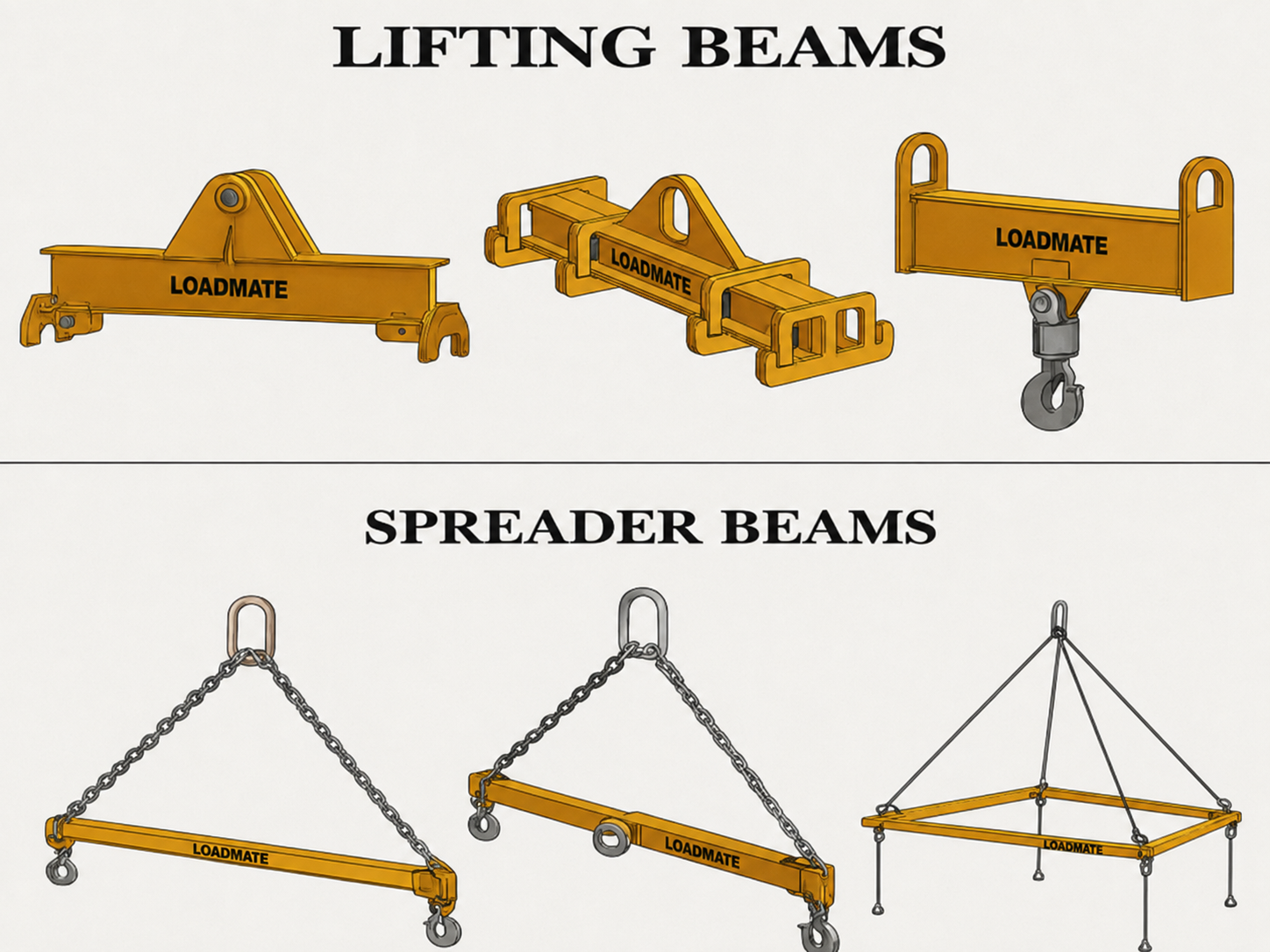
Spreader Beams and Lifting Beams.
Sling a long load from a single hook and two things go wrong: the slings pull inward at an angle, squeezing the load and multiplying the tension each sling carries, and the load swings. A spreader beam fixes both — it holds the lifting points apart, so the slings hang vertical, forces stay predictable, and the load stays level.
LOADMATE manufactures spreader beams and lifting beams to 250 tonnes, in fixed and rotating models, manual or motorised. Every beam is engineered to the specific load: span, lifting-point positions, headroom available, and attachment method. Design is to the applicable structural standard, with a proof-load test and certificate issued for every unit.
Capacity & specification chart.
Indicative ranges across the beam series. Every beam is engineered to its load case — span, lift points and headroom confirmed on the project datasheet.
| Capacity (S.W.L) | MT | 1 | 2 | 5 | 10 | 20 | 30 | 50 | 75 | 100 | 150 | 200 | 250 |
|---|---|---|---|---|---|---|---|---|---|---|---|---|---|
| Span (standard) | Mtr | 1–2 | 1–3 | 2–4 | 2–6 | 3–8 | 3–10 | 4–12 | 4–12 | 6–14 | 6–16 | 8–18 | 8–20 |
| Lifting Points | Nos | 2 | 2 | 2 | 2 | 2–4 | 2–4 | 2–4 | 4 | 4 | 4 | 4–8 | 4–8 |
| Beam Depth (typical) | mm | 150 | 200 | 250 | 300 | 400 | 450 | 550 | 650 | 750 | 900 | 1000 | 1100 |
| Self Weight (approx) | kgs | 35 | 60 | 140 | 260 | 520 | 760 | 1250 | 1900 | 2600 | 4200 | 5800 | 7200 |
| Headroom (typical) | mm | 400 | 500 | 650 | 800 | 1000 | 1150 | 1400 | 1600 | 1850 | 2200 | 2500 | 2800 |
| Proof Test | % | 125 | 125 | 125 | 125 | 125 | 125 | 125 | 125 | 125 | 125 | 125 | 125 |
Conforms to IS 2062 structural steel with design to IS 807. Every beam is proof-load tested and issued with a test certificate. Beams are below-the-hook lifting devices and require periodic statutory inspection in service.
Specification sheet.
Standard ranges — send your requirement and we’ll configure to match.
Design & fabrication
What comes built in as standard.
Optional upgrades & add-ons.
Why a LOADMATE beam.
Removes sling angle force
Slings hang vertical, so tension stays predictable and the load is never squeezed.
Keeps the load level
Balanced lift points stop the swing and tilt that damage long loads.
Engineered per load case
Span, lift points and headroom designed around your actual component.
Proof tested and certified
Every beam tested and issued with a certificate for statutory records.
Fabricated in-house
Cut, welded, NDT-checked and tested at our Surat facility.
Marked for life
SWL, tare and serial permanently marked for inspection and traceability.
Two devices, different jobs.
Spreader beam
Loaded in compression — slings run from the hook to each end, pushing the lift points apart.
Best for: Heavier loads where headroom is available.
Lifting beam
Loaded in bending — hangs from a single central point, load hangs along its length.
Best for: Restricted headroom, or uneven load points.
Industries we serve.
Tap any industry for application detail.
Designed and certified to published standards.
IS 2062
Structural steel
Indian Standard for the hot-rolled steel used in beam fabrication.
IS 807
Design of lifting structures
Design, manufacture, erection and testing of lifting structures.
Proof test
125% load
Every beam proof-load tested with a certificate before dispatch.
ISO 9001 + ZED
Quality & manufacturing
ISO 9001:2015 certified plus ZED Gold tier.
Spreader Beams — technical questions.
What is the difference between a spreader beam and a lifting beam?
A spreader beam is loaded in compression — slings run from the crane hook down to each end and the beam pushes the lift points apart. A lifting beam is loaded in bending — it hangs from a single central point and the load hangs from points along its length. Spreader beams handle heavier loads for their own weight; lifting beams need less headroom. Send us your headroom and load and we will tell you which fits.
Why not just use longer slings?
Because sling angle multiplies force. As slings pull inward from a single hook, tension in each sling rises sharply — at 30 degrees from horizontal each sling carries roughly double the vertical share of the load, and the inward squeeze can crush the load itself. A spreader beam keeps the slings vertical so forces stay predictable.
What does a rotating spreader beam do?
It lets you turn the load while it is in the air — essential when a component must be placed at a different orientation from the one it was picked up in, or turned over for the next operation. Rotation is manual or motorised depending on weight and frequency.
Is a test certificate provided?
Yes. Every LOADMATE beam is proof-load tested and issued with a test certificate. Beams are below-the-hook lifting devices and are subject to periodic statutory inspection in service, which we can cover under an AMC.
Can you make an adjustable-span beam?
Yes — pinned adjustable-span beams let one device cover a range of load lengths. Tell us the shortest and longest load and we will set the pin positions and rate each one.
What is the typical lead time?
Standard configurations typically ship in 4 to 10 weeks from order confirmation. Complex engineered beams take longer, and we confirm a delivery date in writing at the time of order.
Related lifting solutions.
Need a Spreader Beams quote?
Send your requirement and our application engineers respond within 24 hours with a configuration, spec sheet and quote.
- IS 3177 & IS 807Built to Indian crane codes
- 125% load-testedEvery crane, before dispatch
- ISO 9001 · ISO 45001 · ZED GoldQuality & safety certified
- India & 30+ countriesCranes supplied and serviced