
Home / Products / Trolleys / Transfer Trolley
Material Transfer · Rail / Floor
Transfer Trolley
A powered load-carrying trolley that moves heavy loads across shop floors and yards — capacities to 250 tonnes, AC or DC powered, on rail or floor, with no overhead structure at all.
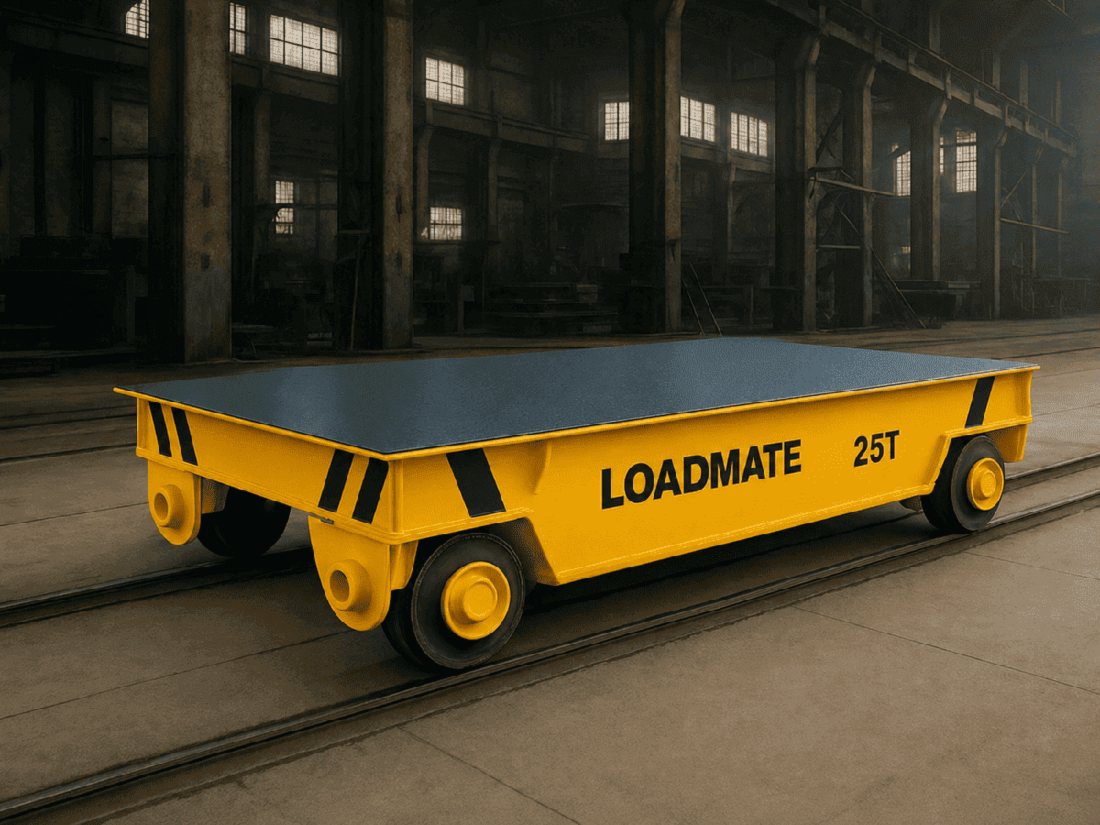
Transfer Trolley.
Not every heavy load needs to go up. Moving a 60-tonne coil, ladle or die from one bay to the next is a horizontal problem, and hanging it from a crane to solve it is expensive and slow. The Transfer Trolley carries the load at floor level and drives it across — no overhead structure, no crane time consumed.
Capacities reach 250 tonnes, AC or DC powered, running on embedded rail or directly on the floor. Deck size, wheel arrangement, drive, power collection and control are engineered to the load and the route. Construction is deliberately simple and heavy — built for years of low-maintenance service in hot, dusty plants.
Capacity & specification chart.
Indicative ranges across the transfer trolley series. Deck size and wheel arrangement are sized to the load — final build confirmed on the project datasheet.
| Capacity | MT | 5 | 10 | 20 | 30 | 50 | 75 | 100 | 150 | 200 | 250 |
|---|---|---|---|---|---|---|---|---|---|---|---|
| Deck Length (typical) | mm | 2000 | 2500 | 3000 | 3500 | 4000 | 5000 | 6000 | 7000 | 8000 | 9000 |
| Deck Width (typical) | mm | 1500 | 1800 | 2000 | 2200 | 2500 | 2800 | 3000 | 3200 | 3500 | 3500 |
| Wheels | Nos | 4 | 4 | 4 | 8 | 8 | 8 | 16 | 16 | 16 | 24 |
| Wheel Dia | mm | 250 | 315 | 400 | 400 | 500 | 500 | 630 | 630 | 710 | 710 |
| Travel Speed | m/min | 20 | 20 | 15 | 15 | 12 | 12 | 10 | 10 | 8 | 8 |
| Motor Rating (approx) | kW | 2.2 | 3.7 | 5.5 | 7.5 | 11 | 15 | 22 | 30 | 37 | 45 |
| Rail Section (typical) | – | CR 60 | CR 80 | CR 80 | CR 100 | CR 100 | CR 120 | CR 120 | CR 120 | CR 140 | CR 140 |
Figures are engineering-typical and vary with deck size, route length and duty. Every trolley is load-tested at 125% of rated capacity before dispatch, with a test certificate issued.
Specification sheet.
Standard ranges — send your requirement and we’ll configure to match.
Mechanical & electrical
What comes built in as standard.
Optional upgrades & add-ons.
Why a LOADMATE transfer trolley.
No overhead structure
Carries the load at floor level — no gantry, no runway, no building steel.
Frees the crane
Bay-to-bay movement stops consuming overhead crane time for heavy work.
Built heavy, deliberately
Simple, over-specified construction for years of low-maintenance service.
Hot-duty capable
Heat-shielded decks and protected drives for foundry and ladle transfer.
Route-engineered
Rail or floor, cable or battery — specified to your layout, not a catalogue.
Manufactured in-house
Designed, fabricated and load-tested at our Surat facility.
Two ways to specify it.
Rail mounted
Runs on embedded or surface-fixed rail with positive guidance.
Best for: Fixed, repeated routes with heavy wheel loads.
Floor running
Travels on the shop floor itself, steered or guided.
Best for: Flexible routes and multi-destination movement.
Industries we serve.
Tap any industry for application detail.
Designed and certified to published standards.
IS 807
Design of structures
Structural design, manufacture and testing of the trolley frame and deck.
IS 3177
Crane component practice
Wheel, bearing and drive practice adopted from Indian crane codes.
125% test
Proof load
Every trolley load-tested at 125% of rated capacity before dispatch.
ISO 9001 + ZED
Quality & manufacturing
ISO 9001:2015 certified plus ZED Gold tier.
Transfer Trolley — technical questions.
What is the difference between a transfer trolley and a cross travelling trolley?
They solve different problems. A cross travelling trolley runs along a crane girder or monorail beam carrying a hoist — it moves the lifting point. A transfer trolley runs on the floor or embedded rail carrying the load itself — it moves the load horizontally with no overhead structure at all.
Does a transfer trolley need rails in the floor?
Not necessarily. Rail-mounted trolleys run on embedded or surface-fixed rail and are the choice for fixed repeated routes, because guidance is positive and wheel loads are carried cleanly. Floor-running trolleys travel on the shop floor itself and suit flexible routes. We recommend based on your route, floor condition and load.
How is a transfer trolley powered?
Four common options: cable reeling drum, festoon, busbar (DSL), or on-board battery. Cable reeling and busbar suit long fixed routes; battery suits routes that cross traffic or where a trailing cable is unacceptable.
Can it carry hot loads from a furnace or foundry?
Yes, with the right build. Heat-shielded decks, insulated wheels, heat-resistant cabling and protected drive components are all available. Tell us the load temperature and exposure time and we will engineer the protection.
What capacity can you supply?
Up to 250 tonnes. Deck size, wheel count and rail section all scale with capacity, so send us the load, the deck size you need and the route length together.
What is the typical lead time?
Standard configurations typically ship in 6 to 12 weeks from order confirmation. Engineered builds take longer, and we confirm a delivery date in writing at the time of order.
Related lifting solutions.
Need a Transfer Trolley quote?
Send your requirement and our application engineers respond within 24 hours with a configuration, spec sheet and quote.
- IS 3177 & IS 807Built to Indian crane codes
- 125% load-testedEvery crane, before dispatch
- ISO 9001 · ISO 45001 · ZED GoldQuality & safety certified
- India & 30+ countriesCranes supplied and serviced