
01
Crane & Hoist Operator Safety
Safe operation of EOT cranes, chain hoists and wire rope hoists: pre-use checks, load limits, hand signals, no-fly zones, and the habits that prevent the accidents every plant fears.
Safety, operation and maintenance programs for crane and hoist teams — delivered by working LOADMATE engineers, on your own equipment at your plant or virtually. Because the strongest safety system in any plant is a trained team.
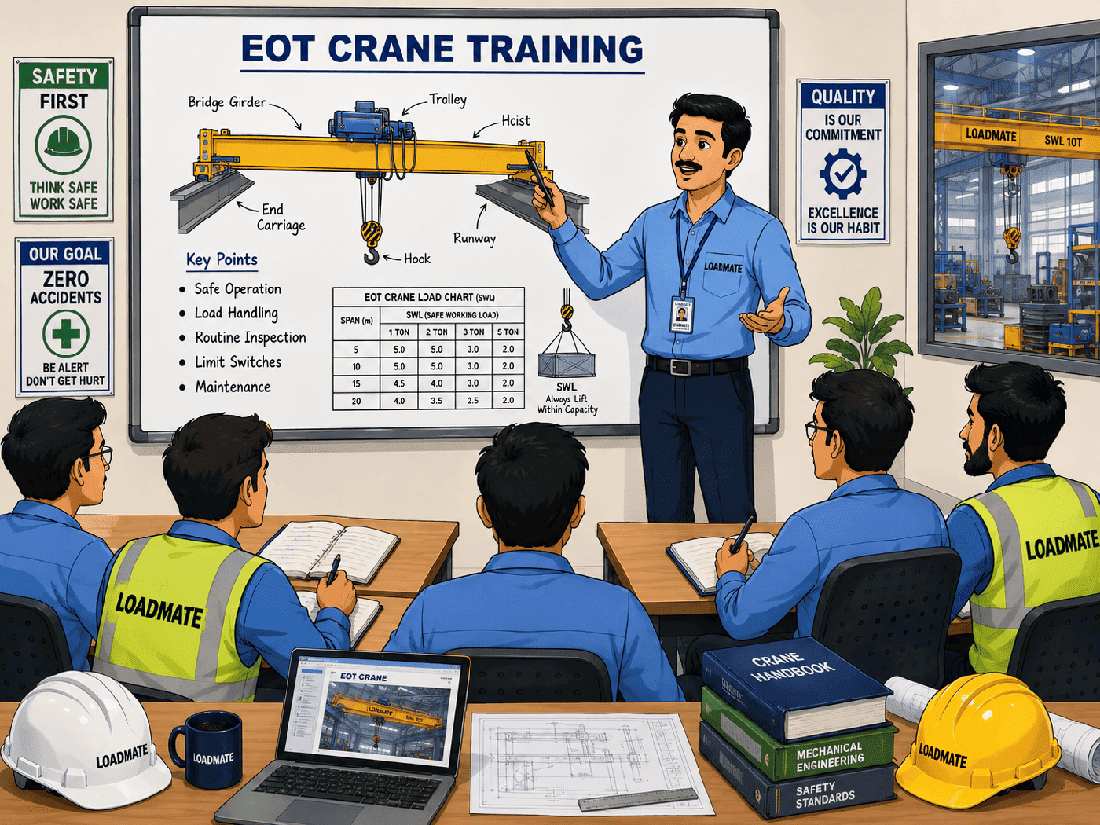
Every program is built from three decades of designing, installing and servicing lifting equipment — taught by the engineers who see, first-hand, what fails and why.
Safe operation of EOT cranes, chain hoists and wire rope hoists: pre-use checks, load limits, hand signals, no-fly zones, and the habits that prevent the accidents every plant fears.
Sling selection, load estimation, centre of gravity, angle factors and inspection of lifting tackle — the discipline that keeps every lift within its rated envelope.
Duty-cycle-based maintenance for electric chain hoists and wire rope hoists: brake checks, chain/rope wear limits, limit switches, lubrication schedules and failure-mode recognition.
For the engineer who owns the bay: inspection regimes, log discipline, operator authorisation, lift planning and when to stop a lift — supervision as a safety system.
What IS 807, IS 3177 and IS 15419 actually require from an owner: periodic examination, load testing, documentation and the compliance trail your auditors and consultants expect.
For the engineers who specify lifting equipment: duty classification, capacity and span selection, headroom planning, girder and structure basics, and what IS 807 / IS 3177 require from a specification.
The hands on the pendant. Certified operators lift safer, faster and with less wear on the equipment.
The team that keeps uptime. Duty-cycle maintenance knowledge cuts breakdowns before they happen.
The compliance owners. IS-code awareness and documented training strengthen every audit.
The specifiers. Understand what to demand from lifting equipment — and from its operators.
The engineers behind the drawing. Learn how duty class, capacity and clearances translate into a safe, right-sized installation.
We train on your equipment, in your bays, on your shifts. Minimum disruption, maximum relevance — the exercises use the cranes your team runs every day.
Hands-on sessions at the LOADMATE facility — equipment opened up, brakes stripped, load tests demonstrated. The factory floor is the best classroom.
Short, structured online modules to keep certified teams current between on-site cycles — ideal for multi-plant rollouts.
Tell us your team size, equipment and what prompted the need — audit, incident, new plant or good discipline.
A short call (or site walk) to map your lifting operations, risks and skill gaps.
A written program outline with duration, batch sizes, prerequisites and proposed dates.
Working engineers — not slide-readers — deliver the sessions, hands-on wherever possible.
Participants receive certificates; management receives an assessment report with recommendations.
The operator safety program changed how our shift talks about lifts. Pre-use checks that used to be a formality are now a habit — and near-misses have dropped.
Practical, hands-on and grounded in our own equipment. The maintenance masterclass paid for itself in the first quarter through breakdowns that did not happen.
The IS-code session gave our EHS team exactly the documentation clarity an audit demands. Clear, specific and delivered by people who obviously live this equipment.
Programs for engineering students and fresh graduates — real industrial exposure to the machines that move Indian manufacturing, delivered at our facility or virtually, with certificates for every participant.
How cranes and hoists actually work: mechanisms, duty cycles, safety systems and the engineering decisions behind them — the bridge between textbook theory and the factory floor.
A structured visit-based program: see manufacturing, assembly and load testing up close, and learn the safety discipline every industrial career is built on.
A deeper engagement for final-year students: project mentorship, applied assignments on real equipment, and a pathway toward internships at LOADMATE.
Seeing a load test on a real EOT crane taught me more in one afternoon than a semester of slides. The engineers answered every question we had.
The fundamentals program connected our machine design subjects to actual hoists on the shop floor. It made career choices feel real for the first time.
Our whole batch left with certificates and a completely new respect for industrial safety. The plant visit was the highlight of our academic year.
Working LOADMATE engineers — the same people who design, build, install and service cranes and hoists every day. Sessions are grounded in real equipment and real failure modes, not generic slides.
Yes. On-site delivery at your plant is our most-requested format — we train on your own equipment, scheduled around your shifts. Virtual refresher modules are also available for multi-plant teams.
Yes. Every participant who completes a program receives a LOADMATE training certificate, and management receives a summary assessment report — useful for audits, customer visits and internal records.
No. Safety, rigging and IS-code programs apply to lifting operations on any make of equipment. Maintenance masterclasses are most valuable on LOADMATE machines but the principles transfer.
Use the Book a Call button on this page or send an enquiry from the contact page. We respond within one working day with a short needs-assessment call, followed by a written program outline.
Tell us about your team and equipment — we’ll respond within one working day with a needs-assessment call and a written program outline.