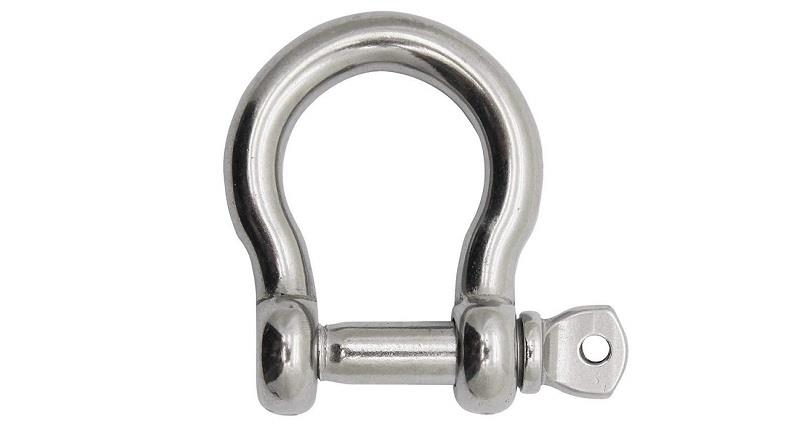
Before knowing the rules of using a shackle, we must fathom its definition. A shackle is a load-bearing connective device that comes with the shape of U. They have numerous uses when it comes to various load securing and rigging applications. With the help of this tool, you can connect numerous types of chains, lifting slings, or ropes to each other. Plus, you can connect them with other objects if necessary. Therefore, we will share the rules of using shackles. Following those rules will help you make the best use of shackles. Here are the rules that you have to follow.
- Rule 1: Whenever you are making a sling, don’t attach the sling legs to the pin. You have to connect them with the bow. If you attach the legs to the pin, there is a possibility that the pin can weaken and damage the sling. Hence, the best option for you is to avoid it.
- Rule 2: If the point loading is a shackle to shackle, you must connect bow to bow. Besides, connecting it bow to pin will also serve your purpose. Make sure not to connect it with a pin to pin. Or else, it may create some unwanted situations.
- Rule 3: Long reach shackles and chain shackles are D-shaped shackles. So, if you are dealing with those shackles, make sure not to sideload. The makers rated and designed them in such a way that they are compatible with in-line applied tension. For that reason, you will find out that the load’s centre line is coinciding with the shackle’s centre line. On the other hand, if you are using anchor body side shackles such as screw pin style, bolt nut cotter anchor body style, and others, you can sideload them. If you are performing this kind of rigging, don’t forget to refer to the reductions present in the rating chart. It will help you to accomplish the best results.
- Rule 4: You should put out the shackle’s bow on the choke’s running side if you are securing a load.
- Rule 5: If you use a shackle with a wire rope, you have to ensure that the shackle is equal to or larger than the diameter of the wire rope.
- Rule 6: When you use a shackle with a synthetic sling, you have to be precise about the size of the shackle. It should be big enough so that you can avoid binding or pinching the sling.
- Rule 7: There is one thing that you have to make sure that you should not subject your shackle to high or low temperature. Otherwise, it may affect the strength or thermal treatment of the shackle. The operating range of the shackle is between -4F to 400F. To be precise, it is the working load limit.
- Rule 8: You have to engage the shackle pins precisely, and it is one of the most important things you have to do. You must engage the threads of the screw pin shackles precisely to the ear of the shackles. The pinhead should be in contact with the shackle body. Cotter shackles and bolt nuts have to ensure that the nut and bold are secured properly with the help of the attached cotter pin.
- Rule 9: If you are using the shackle for a semi-permanent application or planning to suspend a load, we suggest you use bolt nut cotter anchor style shackles. If you want to remove shackles after completing the lifts, screw pin shackles will be your ideal choice. Plus, if you have plans to use a screw pin shackle to suspend the load for a specific time length, we would advise you to tie off the pin to the shackle’s body with the help of the wire.
So, these are the important rules that you have to follow if you are using shackles. Following these rules and inspecting the shackles before use will help you a lot. You will be able to use your shackles precisely. Do you know the difference between Forging Shackle and Casting Shackle?
Six Conditions to Check Before Using a Shackle
1st condition
If you see that any part of the Shackle has worn down more than 10% compared to the original dimension, it is time to get a new one. If you find out about this condition, you can make sure that the size of the Shackle has come down. Therefore it will not be able to take the suitable load. Therefore, it can be dangerous and attract numerous unwanted accidents.
2nd condition
Your Shackle will indicate heat damage after using it for a long time. It is because, during the manufacturing process, a shackle goes through heat treatment. Therefore when you expose it to extreme heat, the reverse process starts to take place. It hampers the quality of the Shackle. Sometimes it becomes a tough job to fathom the signs of heat damage. Hence, you have to check for some key items that will indicate heat damage to the Shackle. Here are the items.
- If the straw is becoming blue or going through a discolouration, you have to understand that the Shackle is suffering from heat damage.
- There is a possibility that the weld spatter will land on your Shackle. It happens when the metal's molten dots transfer into the Shackle immediately. This phenomenon changes the properties of a shackle.
3rd condition
If the Shackle changes from its original shape, it is an indicator that shows the degradation of the Shackle. In case you notice any distortion, you should change the Shackle without wasting any of your time. For instance, elongated, stretched, bent, twisted, broken, or cracked shackles are the signs of distortion. Therefore, you have to remove it from your service as soon as you notice any of these issues.
4th condition
Maybe, your Shackle has imprudent corrosions, gouges, nicks, or pitting. If any of these things take place in your Shackle, don't forget to get rid of it from your service. Well, corrosion is one of the effects of excessive pitting. If these things happen to your Shackle, the dimension of your Shackle will come down. Therefore it cannot withstand the rated capacity.
5th condition
Damaged threads and bent load pins are the visible signs of the degradation of the Shackle. If you notice the bent pins, you have to understand that they overcame their elastic limit. In this situation, using the pins can be a harmful decision. If you continue using the Shackle, there will be a possibility of a dropped load. It will injure the operators and cause damage to your property. Consequently, the damaged threads will show that the pins are not in 100% contact with the Shackle. It may lead to the Shackle's failure.
6th condition
You have to change the Shackle as soon as possible if you don't find any manufacturer's trademark or name. You will find numerous things in the Shackle, such as trace, size, and code. It will also comprise the working limit of the Shackle. If you don't find any of these things in your Shackle, look for another one.